


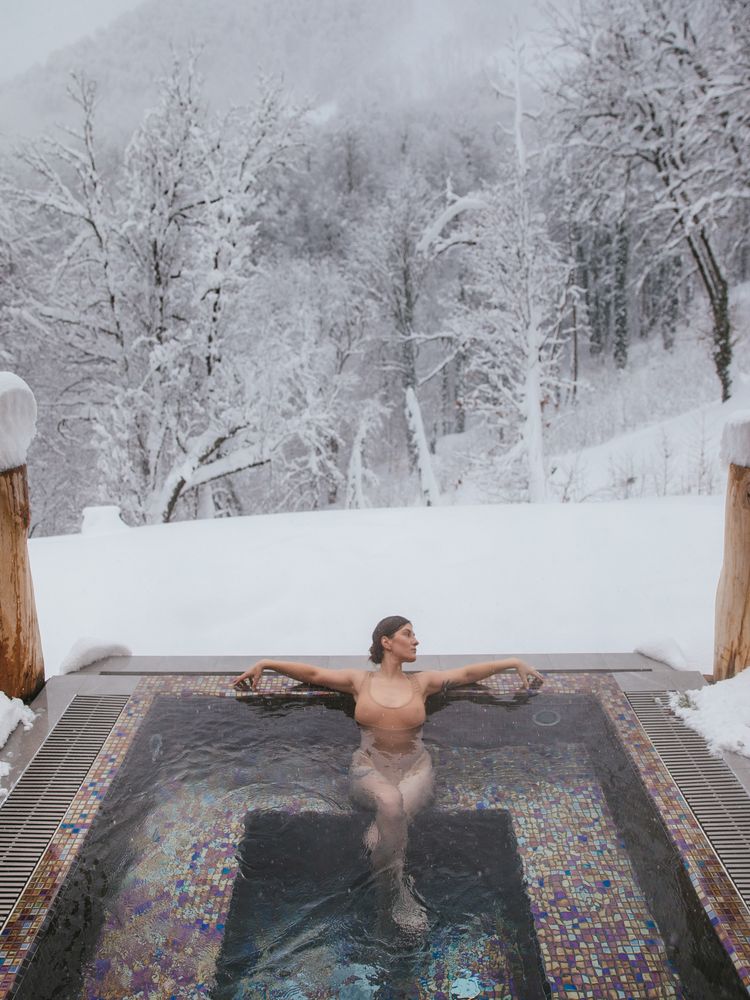
Yes — you can use an inflatable hot tub in winter, down to about 40°F (4°C) ambient, and colder if your model has freeze protection and you insulate it properly. But “can” is doing a lot of work in that sentence. Running an inflatable through a real winter costs 30–50% more than summer operation, heats slowly, and demands discipline about covers and filters. Some owners love winter soaking enough to pay it. Others are better off draining and storing. This guide gives you the honest math so you can decide which one you are.
Disclosure: As an Amazon Associate, we earn from qualifying purchases.
If you’re shopping for a winter-capable model rather than winterizing the one you have, our buying hub covers which inflatables actually handle cold. This page is for everyone else: the owner with a tub already on the patio, watching the forecast drop.
The 40°F line: why temperature limits exist
Every manufacturer publishes a minimum operating temperature, and they’re not suggestions. Bestway’s Lay-Z-Spa manuals state the tub should not be used or left filled when ambient temperatures are expected to fall below -10°C (14°F); Intex is more conservative, rating the PureSpa for use down to 4°C (39°F) ambient. Below those floors, two things fail:
- The vinyl gets brittle. Cold PVC loses flexibility. Bumping, sitting on, or even folding a frozen liner can crack it — and a cracked liner in January is a write-off, not a repair.
- The pump freezes. If water inside the pump or hoses freezes, it expands and cracks housings and fittings. This is the expensive failure: a frozen pump on an inflatable usually means replacing the pump unit.
Note the gap between the two brands’ numbers: 14°F vs 39°F. That’s not a typo — it’s a difference in how much cold-weather engineering each manufacturer builds in, and it tells you something important: an inflatable’s winter survivability is a feature of the specific model, not the category. A tub bought for summer-only use and a tub bought with winter in mind are different purchases.
Freeze Shield: what it actually does
Bestway’s Freeze Shield (also sold under the Coleman badge on US models) is the cold-weather system on most winter-capable inflatables. Here’s what it is, minus the marketing:
It’s an automatic anti-icing routine. When the water temperature drops toward freezing, the system runs the pump and heater just enough to keep the water moving and hold it around 6–10°C (43–50°F) — well above freezing, well below soaking temperature. If it can’t maintain that — power cut, pump failure — it throws an alarm so you know before ice forms.
What Freeze Shield is not: it doesn’t make the tub efficient in winter, it doesn’t protect the tub if you turn it off or unplug it, and it doesn’t help at all if the tub isn’t filled and running. It’s a last line of defense for a running tub, not a substitute for insulation.
Which of our reviewed models have it? The Coleman Palm Springs (reviewed here) carries Freeze Shield and is the model we point winter-curious buyers toward first. Bestway’s EnergySense line adds improved insulation to the freeze protection — that combination is the current state of the art for inflatables, and the price premium is the one winter upgrade we’d actually pay for rather than DIY around.
The insulation stack: what actually keeps heat in
An uninsulated inflatable in winter is a space heater pointed at the sky. The fixes stack — each layer cuts the heating bill, and together they can halve it:
- Underneath: an EVA base mat. Heat bleeds straight into cold ground or concrete. Interlocking EVA foam tiles under the tub are the single highest-impact cheap upgrade — they also protect the liner from abrasion. If you do one thing on this list, do this.
- On the water: a floating thermal blanket. Most heat escapes from the water surface. A floating spa blanket (cut to fit) sits on the water under the fitted cover and cuts evaporation — which is where the majority of heat loss happens. Owners who’ve measured before and after consistently report this as the second-biggest saver.
- Around it: a windbreak. Wind strips heat from the tub’s walls faster than still cold air. A fence panel, privacy screen, or even positioned patio furniture on the windward side makes a measurable difference. It’s free if you already have the furniture.
- On top: a fitted, intact cover. The factory cover is your primary defense — but only if it fits properly and isn’t waterlogged. A sagging, heavy, ill-fitting cover is a hole in the budget. Our covers guide covers when a replacement pays for itself in energy savings.
Skipping all four and running through winter is how you get the horror-story electricity bills. Doing all four is how owners in cold climates keep it merely expensive instead of ruinous.
Heat-up reality: the 24-hour tub
Set expectations now: an inflatable heats at roughly 2–3°F per hour from a standing start (slower in wind, faster if insulated). From a cold fill at 60°F tap water to 104°F is realistically 18–24 hours of continuous heating.
This is why winter owners leave the tub at temperature rather than heating from cold each time — and why the “leave it on or turn it off?” question matters more in winter than any other season. If you’re weighing cycling the heater to save money, read our honest breakdown of the on-vs-off decision first; the short version is that in winter, turning it off invites the freeze risk that destroys pumps, so the calculation changes.
What winter actually costs
Here’s the honest number range, based on owner-reported data and heater-wattage math:
- Mild winter (40–55°F days): roughly 30–50% above your summer electricity cost for the tub.
- Real winter (20–40°F): roughly double summer cost, more if uninsulated or windy.
- Deep cold (below 20°F sustained): 2–3× summer cost, and you’re operating below the manufacturer’s stated floor — this is enthusiast territory, not sensible ownership.
Those are multipliers, not absolutes, because your baseline depends on your electricity rate and your tub’s heater (most inflatables run a ~1.3 kW heater). Plug your own numbers into our running-cost calculator — run it once with summer rates and once with the winter uplift, and look at the 5-year difference in our ownership planner. For some owners the delta is £100/year and obviously worth it. For others it’s the price of a holiday. Know which you are before October, not after the January bill.
Winter water chemistry: less forgiving, not less important
Cold changes the chemistry picture in three ways:
- Less evaporation, but sanitizer still depletes. Cold water slows evaporation but your sanitizer burns off with use just the same. Don’t let the cold fool you into skipping tests — untested winter water goes cloudy just as fast, and a midwinter drain-and-refill is miserable.
- Filters work harder. The pump runs longer heating cycles, which means more water through the filter and faster clogging. Check and rinse the filter more often than the standard schedule suggests — monthly at minimum, and keep a spare cartridge so you can rotate.
- Balance before the deep freeze. Get alkalinity and pH dialed in before the coldest weeks. Adjusting chemistry with numb hands in sleet is how mistakes happen. New to the process? Our beginner’s water-care guide and dosing calculator take the guesswork out.
Winter safety: the part nobody glamorizes
- GFCI, always. Wet snow, extension-free direct outlet, test the GFCI monthly. Winter moisture is relentless; a tripping GFCI is protecting you, not annoying you. If it trips repeatedly, that’s a fault to fix, not a button to keep resetting.
- Non-slip everything. The path from your door to the tub is the most dangerous part of winter soaking. Ice + wet feet + steps is a hospital visit. Lay down outdoor matting or grit, and keep it maintained.
- Shorter soaks. 15–20 minutes in winter is plenty — the cold air on your head while your body is at 104°F is a bigger thermal shock than summer soaking. Get out before you feel lightheaded, not after.
- Never leave it unattended in a freeze without Freeze Shield confirmed working. If the power’s out or the pump’s throwing codes, a filled tub in a hard freeze is a countdown. Check the troubleshooting tree if anything looks wrong — error codes in winter are urgent, not “deal with it at the weekend” problems.
The honest alternative: when to winterize and store instead
Here’s the section most winter guides won’t write, because it doesn’t sell tubs: winterizing is the right call for a lot of owners. Drain the tub completely, clean and dry it, deflate, fold loosely (never fold a cold-stiff liner — warm it indoors first), and store it somewhere it won’t freeze solid. It takes an afternoon and costs nothing.
Winterize instead of running if:
- Your model has no freeze protection and your climate drops below freezing regularly.
- You soak less than once a week in winter — the per-soak cost becomes absurd.
- You travel for the holidays and can’t monitor the tub.
- Your electricity rate is high and the 2–3× multiplier genuinely hurts.
There’s no shame in it. A stored tub costs nothing and lasts longer; a frozen cracked pump costs hundreds. The tub will be there in April.
The decision: run it or store it?
| Your situation | Verdict | Why |
|---|---|---|
| Mild climate (rarely below 40°F), Freeze Shield model, soak weekly+ | Run it | Cost uplift is modest, risk is low, winter soaking is genuinely great. |
| Cold climate (20–40°F), Freeze Shield model, full insulation stack, soak weekly+ | Run it — with discipline | Works, but budget double the summer cost and check filters/covers religiously. |
| Any climate below the manual’s floor, no freeze protection | Store it | You’re gambling a pump replacement against a season of soaks. The math doesn’t work. |
| Soak less than weekly in winter, whatever the climate | Store it | Per-soak cost is indefensible; a stored tub costs nothing. |
| Away for weeks over winter | Store it | An unmonitored tub in a freeze is a countdown, not a plan. |
Winter FAQ
Will the pipes burst if the power goes out?
Not immediately. A filled, covered tub holds heat for many hours — you have a window, not minutes. But if the power is out for a day in a hard freeze with no heat, you’re in drain-it-now territory. Freeze Shield can’t work without power; nothing can.
Can I set up a new inflatable in winter?
Yes, with one critical rule: inflate the liner somewhere warm first. Bestway’s manuals specify inflating above 15°C (59°F) — cold vinyl cracks when unfolded and handled. Inflate indoors, carry it out, then fill. Fill with the warmest tap water you have to shorten the 24-hour heat-up.
Does the cover freeze shut?
The cover itself can ice over in freezing rain — never force it or pour boiling water on it (thermal shock cracks vinyl). A cover lifter or a gentle nudge after the ice softens in daylight is the safe approach. A floating thermal blanket underneath means you’re not losing heat even if the cover is slow to open.
Should I lower the temperature between soaks in winter?
A small setback (a few degrees) saves a little; a big drop invites reheat times measured in half-days. In deep cold, we don’t recommend turning it off between soaks at all — the freeze risk outweighs the savings. See our full on-vs-off analysis.
The bottom line
Inflatables can absolutely do winter — but the ones that do it well have freeze protection, insulation, and an owner who understands the cost. If that’s you, the January soak under snowfall is the best the hobby gets. If it isn’t, drain it, fold it warm, and see it in April. Either way, decide now, in October — not when the forecast says 25°F and the pump is throwing E03.
Run the numbers for your climate and rate in the 5-year cost calculator, and if you do run through winter, fold the extra filter checks into your maintenance schedule.


